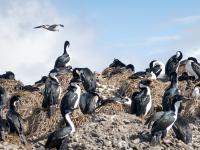
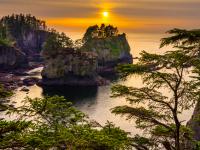
Throughout this expedition, every turn reveals another breathtaking panorama, offering unparalleled opportunities to experience Patagonia's wild and untamed beauty up close. Please note, this trip is an expedition, and sites mentioned in this itinerary may vary depending on the conditions during the trip. Over the coming days, journey through one of Patagonia's most spectacular wilderness regions. It is a landscape of snow-capped mountains, glacier-fed waterways, ancient icefields, and forested islets scattered across a maze of fjords. Here, towering granite cliffs rise dramatically from the sea while countless waterfalls cascade from hanging valleys carved by millennia of glaciation. This remarkable region, known as Glacier Alley, forms part of a vast UNESCO Biosphere Reserve that protects the Magallanes Sub-Antarctic Evergreen Rainforest. Shaped by the retreat of massive glaciers, these fjords and channels support an extraordinary diversity of wildlife and pristine ecosystems found nowhere else on Earth. Your expedition begins by exploring the tidewater glaciers at the head of the fjords on the south side of the Cordillera Darwin Icefield. These glaciers are part of the Alberto de Agostini National Park, where the rugged Andes plunge directly into the fjords. Here, explore by Zodiac and ship, approaching the striking glaciers and their towering ice fronts. We will exit the Beagle Channel's western entrance and poke briefly out to sea before entering Canal Cockburn to explore the northwest side of the Darwin Icefield via Seno Agostini, a glacier-carved inlet fed by numerous glaciers cascading from the surrounding mountains. Cruise among floating ice aboard Zodiacs, navigating through brash ice and bergy bits while searching for wildlife along the shoreline. With luck, you may witness the awe-inspiring spectacle of glacier calving as immense blocks of ice break free and crash into the icy waters below. Traveling northwest up the Strait of Magellan overnight and heading northbound through the maze of channels, there is an opportunity to explore the Magallanes Region of Southern Chile, known for its deep waters, scenic fjords, and rich wildlife. Expeditioners can observe Chilean dolphins, Peale's dolphins, and a variety of bird species such as the thorn-tailed rayadito, ringed kingfisher, and crested caracara. The lush vegetation includes beech forests and flowering plants like chilco fuchsia, chapico taique, and copihue, which attract hummingbirds such as the green-backed firecrown. The area's natural beauty makes it a popular destination for wildlife photography and eco-tourism. Sailing north along Canal Concepcion, a maze of interlocking fjords guides us toward the entrance of Pio XI-named in honor of Pope Pius XI by Father Alberto de Agostini, the Italian missionary and explorer who, in 1931, became the first person to cross the Southern Patagonian Ice Field. Of the 48 glaciers fed by this vast ice field, nearly all are in retreat, with one remarkable exception: Pio XI. For more than 80 years it has advanced rapidly and continuously, defying the global trend of glacial recession. Scientists have yet to fully explain this anomaly, making the opportunity to witness Pio XI up close a rare privilege in a changing world. Pio XI marks the northernmost point of our voyage. From here, we turn south again, taking time to explore the many caletas and sheltered puertos we passed during the night. The names are invocative such as Caleta Moonlight Shadow. The many anchorages offer excellent opportunities for Zodiac exploration, and if conditions allow, we may go ashore where the dense forest gives way to open tundra. Whenever the landscape and weather present the chance for a hike, we will seize it. Returning southeast through the Strait of Magellan to Seno Almirantazgo, it is possible to explore the northern shores of the Cordillera Darwin Icefield. A selection of guided hikes offers the opportunity to explore the region's sub-Antarctic forests, where moss-draped trees and glacially sculpted landscapes lead to spectacular viewpoints overlooking the Marinelli Glacier and the surrounding mountains. Later, board Zodiacs for an unforgettable wildlife excursion to Tucker Islets in Almirantazgo Sound. To protect this important breeding habitat, landings are not permitted, but your Zodiac cruise will bring you close to the shoreline for exceptional wildlife viewing. Observe a thriving colony of more than 4,000 Magellanic penguins as they gather along the beaches and rocky slopes. Keep watch for Chilean skuas and imperial cormorants overhead, while dolphins may make an appearance in the sheltered waters surrounding the islands. Traveling back northeast along the Strait of Magellan, we will attempt to land at Bahia Fortescue. This is a notoriously challenging place to access, as the strong, persistent winds that sweep through this region often make landings difficult. Despite the conditions, it is a site of great historical significance. It was here that the first Christian mass on Chilean territory was celebrated by Fray Pedro de Valderrama on 11 November 1520, celebrating Magellan's fleets discovery of the western exit of what is now known as the Strait of Magellan. In the evening of Day 10, enjoy the Captain's Cocktail Party and Farewell Dinner to celebrate the end of a memorable adventure in this magical part of the world. ...
Read More



 Track this Cruise.
  Favorite this Cruise and receive Price Alerts when the rates go up or down.